






This article may include affiliate links. We may earn a small commission if you shop through them.
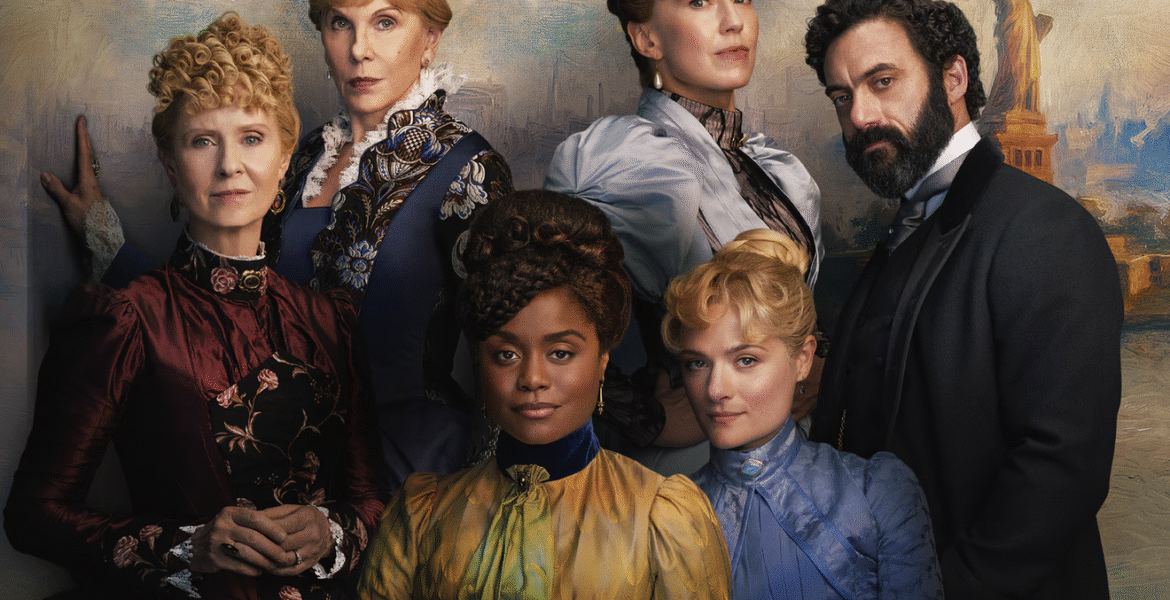
HBO’s The Gilded Age is back this week! You can watch the new season premiere November 1st at 9pm and we could not be more excited.
The Gilded Age, Season 4: Your Sunday Night Schedule
- Nov 1: Season premiere
- Nov 8: Episode 2
- Nov 15: Episode 3
- Nov 22: Episode 4
- Nov 29: Episode 5 (Thanksgiving weekend)
- Dec 6: Episode 6
- Dec 13: Episode 7
- Dec 20: Season finale
Season 4 of the show moves into 1885–86. That means President Grover Cleveland is in town, John D. Rockefeller is circling, and the Statue of Liberty is about to arrive in the harbor. Bertha is hiding a crumbling marriage, and Agnes is plotting her comeback over a presidential dinner.
Some of you already love the marble mansions in Newport and ballrooms on Fifth Avenue (and many of you know I love to visit yearly).
But the show leaves something out. In those same years, Cuban exiles, Latin American heiresses, and a half-Cuban duchess were already part of New York society.
What Was Really Happening in Latino New York in 1885–86
While the Russells and van Rhijns fight over dinner invitations, a whole Latin American world was living a few blocks away.
New York was home to thousands of Cuban exiles who had fled Spain’s crackdown during the Ten Years’ War. Among them was José Martí, the poet and future hero of Cuban independence. He spent these years writing about American life for newspapers across Latin America, including the city’s high society.
In 1885, the widow of Guatemala’s president moved to Fifth Avenue. Her home at 855 Fifth Avenue became a social hub for Latin American diplomats, artists, and exiles. In 1886, the year Season 4 ends, a U.S. newspaper ran a feature calling her and another Latin American woman in fashionable New York “among the most notable women of the century.”
So when you watch Agnes plan her presidential dinner, picture this: just up the avenue, a former First Lady of Guatemala was throwing parties of her own.
Consuelo Yznaga: The Cuban American Girl Who Became a Duchess
Consuelo Yznaga’s father, Antonio, came from one of Cuba’s most powerful families. Antonio became a U.S. citizen and changed Iznaga to Yznaga. He raised his children between New York, Louisiana, and a summer cottage in Newport.
Old-money New York didn’t know what to make of the family. They had money, but they were Cuban, Southern, and a little too “bohemian” for Mrs. Astor’s famous 400.
Consuelo was not the kind of debutante old New York wanted. As a teenager in London she smoked cigars and played the banjo. At one dance back home, she showed up without a corset, which horrified her chaperone. The future King of England liked the family so much that he came over for buckwheat pancakes.
Consuelo went around them anyway. In 1876, before a crowd at Grace Church in New York, she married the heir to the Duke of Manchester. She was one of the first American women to marry into a British dukedom. Later she joined the inner circle of the Prince of Wales, the future King Edward VII.

Then she came back to New York. In 1883, her best friend Alva Vanderbilt threw what’s still called the party of the century, and Consuelo was the guest of honor. The women who had once refused to call on her now had to greet her on the staircase.
Edith Wharton later used her as the model for the character Conchita in The Buccaneers. A Cartier tiara that Consuelo helped design is now in the Victoria and Albert Museum.
Her marriage, the money, and what Mrs. Astor did that night are stories for another day.
The Chilean Woman at the Root of the Vanderbilt-Cooper Line
Many fans of Anderson Cooper’s Vanderbilt and Astor don’t know this part of his family tree: it runs straight through Santiago, Chile.

In the 1860s, a Chilean woman named Luisa Fernández de Valdivieso married an American Union general serving as U.S. minister to Chile. Her granddaughters were the famous Morgan twins, Gloria and Thelma. Their dark hair and dark eyes made them celebrities on both sides of the Atlantic.
Society pages called the twins “the Magnificent Morgans.” Their grandmother’s Chilean roots were rarely mentioned, but her looks were passed down: dark eyes, dark hair, and the kind of glamour that would define the Vanderbilt name for the next century.
Gloria married Reginald Vanderbilt and became the mother of “Little Gloria” Vanderbilt. Little Gloria was Anderson Cooper’s mother. Thelma married a British viscount and ended up close enough to the British throne to play an accidental part in one of the biggest royal scandals of the twentieth century.
So one of the most famous American dynasties has a Chilean grandmother, and almost nobody tells it that way.
Why These Stories Disappeared
The Latin Americans of the Gilded Age weren’t rare. They included Cuban sugar barons, a Peruvian fertilizer magnate who built one of Newport’s earliest mansions, Mexican diplomats, and Cuban exiles who threw some of the best parties on Fifth Avenue. Their names show up in guest lists, society columns, and mansion ledgers. But no one remembers them. We start today.
Every Sunday this season, I’ll share the Latino history happening just outside the frame of that week’s episode. Subscribe to our newsletter, and follow us on IG and TiKTok for the smaller versions.
Were there Latinos in the Gilded Age?
Yes. Cuban sugar families, Peruvian fertilizer magnates, Mexican diplomats, and Chilean heiresses lived in New York and Newport, attended society balls, and married into families like the Vanderbilts.
Who was Consuelo Yznaga?
She was a Cuban American socialite, born in New York in 1853, who married the heir to the Duke of Manchester and later became Duchess of Manchester. She was a close friend of Alva Vanderbilt and an inspiration for Edith Wharton’s The Buccaneers.
Does Anderson Cooper have Chilean ancestry?
Yes. Through his mother, Gloria Vanderbilt, his family tree traces back to Luisa Fernández de Valdivieso of Santiago, Chile.
Where can I see Consuelo Yznaga’s tiara?
The Manchester tiara, made by Cartier, is held by the Victoria and Albert Museum in London.
When does The Gilded Age Season 4 premiere?
Sunday, November 1, 2026, at 9pm ET/PT on HBO and HBO Max.