



This article may include affiliate links. We may earn a small commission if you shop through them.
This article contains affiliate links. Purchases may earn Señora Era a commission at no extra cost to you.
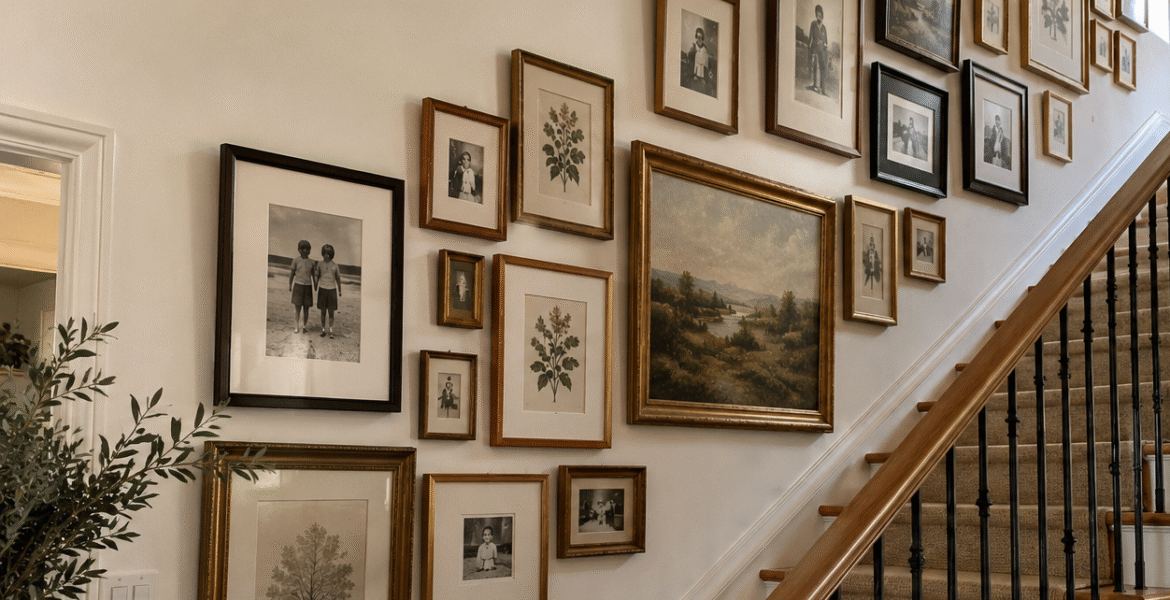
Transform an empty staircase into a beautifully curated gallery wall with family photos, artwork, and frames you love.
A staircase is one of the most overlooked decorating opportunities in a home. We walk past it every day, yet the wall alongside it often remains completely bare.
A thoughtfully arranged stairway gallery wall can transform that empty space into something beautiful and personal. Whether you want to display family photographs, collected artwork, vintage finds, or a combination of all three, a gallery wall adds warmth, character, and a sense of history to your home.
The challenge, of course, is figuring out where everything should go.
Unlike a gallery wall above a sofa or console table, a staircase arrangement needs to follow the natural angle of the stairs while still feeling balanced and intentional.
Fortunately, creating one is easier than it looks. With a little planning, the right frame arrangement, and a few simple tools, you can create a staircase gallery wall that feels professionally designed without hiring an interior decorator.
Here’s exactly how to do it.
What You’ll Need to Create a Stairway Gallery Wall
Before you start putting holes in your walls, gather a few supplies.
- Picture frames in different sizes: A combination of small, medium, and large frames creates visual interest.
- Artwork and photographs: Family portraits, landscape prints, vintage artwork, botanical illustrations, or meaningful keepsakes.
- Kraft paper or paper templates: To plan the arrangement before hanging anything.
- Painter’s tape: For temporarily securing paper templates to the wall.
- Measuring tape: To determine spacing and placement.
- Level: To ensure every frame hangs straight.
- Pencil: For marking placement and hanging points.
- Picture hooks, nails, or wall anchors: Choose hardware appropriate for your wall material and each frame’s weight.
- Hammer or drill: Depending on your hanging hardware.
Señora Era tip: You don’t need to purchase all-new artwork. Combining vintage pieces, family photographs, and inexpensive prints often produces a more interesting gallery wall than buying an entire matching collection.
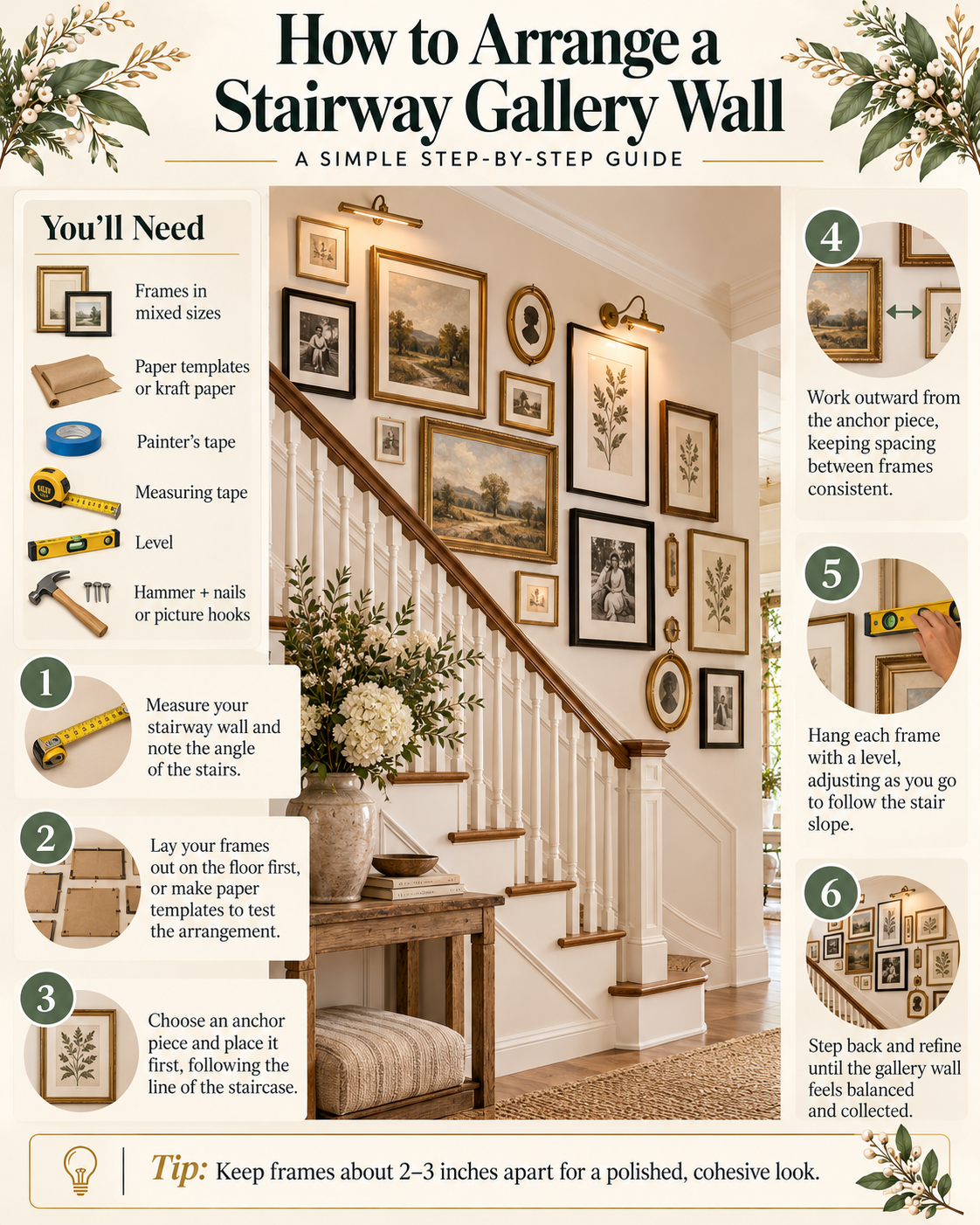
Step 1: Measure Your Stairway Wall
The first step is understanding the space you’re working with.
Measure the length of the wall along the staircase and take note of the angle created by the stairs and handrail.
You’ll want your gallery wall to follow this diagonal line rather than arranging everything in perfectly horizontal rows.
Think of the staircase itself as your design guide.
A common approach is to establish an imaginary diagonal line running parallel to the stairs, then arrange your artwork around it.
As a starting point, you might position the visual center of the arrangement roughly 57–60 inches above the stair treads, measured vertically from the relevant step. Adjust for your staircase’s proportions, sightlines, handrail height, and the size of your artwork.
The goal is to create a comfortable viewing height as someone walks up or down the staircase.
Before committing to a layout, consider where the gallery wall will begin and end. You might cover the entire staircase wall or concentrate the arrangement around the most visible section.
Step 2: Arrange Your Frames Before Hanging Them
This is one of the most important steps, and it’s the one most people are tempted to skip.
Before making any holes, lay your frames out on the floor.
Start experimenting with different arrangements, mixing frame sizes, orientations, and styles.
Try placing a larger piece near the middle and surrounding it with smaller artwork.
You can also trace each frame onto kraft paper, cut out the shapes, and tape them to the wall.
Paper templates are especially useful for staircases because they let you see how the arrangement follows the slope before you install anything.
Move the templates around until you find a composition you love.
A few things to consider:
- Mix vertical and horizontal frames for visual interest.
- Avoid placing all the largest frames on one side.
- Distribute darker frames throughout the arrangement.
- Use smaller frames to fill gaps between larger pieces.
- Include a combination of photographs, illustrations, and artwork.
Take a photograph of your preferred layout before you begin hanging the frames.
That way, you’ll have a visual reference as you work.
Step 3: Start With an Anchor Piece
Every beautiful gallery wall needs a starting point.
Choose one larger or visually significant piece to serve as your anchor.
This might be an oversized family photograph, a vintage landscape painting, a meaningful piece of art, or a large botanical print.
Position it near the middle of your planned arrangement, following the natural direction of the staircase.
Your anchor piece doesn’t have to be perfectly centered on the wall. It simply needs to provide a visual foundation for the surrounding artwork.
Once you’re happy with its placement, hang it using hardware suitable for the frame’s weight and your wall construction.
Use a level to make sure the frame is straight.
Designer-inspired tip: A large vintage-style landscape painting in a warm gold frame can serve as a beautiful anchor for a staircase gallery wall, especially when paired with family photographs and smaller botanical prints.
To complete your gallery, view our Wall Art & Tapestries edit.
Step 4: Work Outward and Keep Spacing Consistent
With your anchor piece in place, begin arranging the remaining frames around it.
Work outward in both directions, gradually following the slope of the staircase.
For a cohesive appearance, aim for approximately 2–3 inches between neighboring frames as an initial guideline.
The exact distance can vary depending on the sizes of your artwork and the overall style you’re trying to achieve.
Smaller gallery walls may look best with tighter spacing, while larger arrangements can accommodate slightly more breathing room.
Consistency matters more than achieving an identical distance between every frame.
You’ll also want to create balance between the different frame finishes.
If you’re mixing black, brass, and wood frames, distribute those finishes throughout the arrangement rather than grouping every matching frame together.
This makes the gallery wall feel collected and intentional.
Step 5: Hang Each Frame Straight
As you begin securing each piece, use a level to keep the frames straight.
Although the overall arrangement should follow the angle of the staircase, the individual frames should generally remain level with the floor rather than tilting to match the stairs.
Mark each hanging point carefully, accounting for the distance between the top of the frame and its hanging hardware.
For heavier artwork, use appropriate anchors or fasteners into suitable wall framing when required. Check the load rating and compatibility of your hardware rather than relying on adhesive strips for valuable or heavy pieces.
Continue working outward, pausing occasionally to assess the arrangement from the bottom and top of the stairs.
If something looks uneven, adjust the next pieces before continuing.
It’s much easier to correct spacing as you go than to rearrange everything after the gallery wall is complete.
Step 6: Step Back and Refine Your Gallery Wall
Once all your artwork is hanging, take a few minutes to look at the overall composition.
Walk up and down the staircase and observe how the pieces work together from different angles.
Does one side feel heavier than the other?
Are the larger frames distributed throughout the arrangement?
Does the gallery wall follow the staircase naturally?
Are there any awkward gaps or areas that feel too crowded?
Sometimes moving a single piece a few inches can make the entire composition feel more balanced.
Remember, your gallery wall doesn’t need to be perfectly symmetrical.
In fact, some of the most beautiful gallery walls have a slightly organic, collected-over-time appearance.
The goal is to create something that feels personal, cohesive, and natural to your home.
How Far Apart Should Pictures Be on a Stairway Gallery Wall?
One of the most common gallery wall questions is how much space to leave between frames.
For most arrangements, a gap of approximately 2–3 inches is a useful starting point.
However, different styles may benefit from different spacing.
| Gallery wall style | Suggested frame spacing |
|---|---|
| Tightly arranged gallery wall | 1–2 inches |
| Classic mixed-frame gallery wall | 2–3 inches |
| Relaxed, collected arrangement | 3–4 inches |
| Large statement artwork | 4–6 inches or more |
These are design guidelines rather than fixed rules.
For a stairway gallery wall featuring mixed frame sizes, aim for a relatively consistent amount of negative space while allowing the arrangement to follow the stairs.
Should All Your Gallery Wall Frames Match?
Absolutely not.
In fact, mixing frames can make a gallery wall feel more sophisticated and personal.
For a timeless look, consider combining three finishes:
Antique brass or gold: Adds warmth and a collected, vintage-inspired quality.
Black: Creates contrast and helps anchor lighter artwork.
Natural wood: Softens the arrangement and makes the gallery wall feel inviting.
You can also mix frame shapes. Oval frames, small antique-style portraits, and larger rectangular artwork create visual variety.
If you prefer a minimalist aesthetic, sticking to one frame finish can be equally beautiful.
What matters most is creating a consistent overall mood.
For example, if your artwork features warm neutrals, botanical illustrations, and vintage landscapes, a mix of brass, black, and walnut frames can feel cohesive even when none of the frames match.
What to Put in a Staircase Gallery Wall
One of the best things about a gallery wall is that there’s no single right way to fill it.
You can create an arrangement around a specific theme or combine several types of artwork.
Here are a few ideas we love.
Family Photographs
A staircase is a wonderful place to display family memories.
Consider mixing black-and-white family portraits with candid photographs, childhood pictures, and meaningful moments from different generations.
Using a combination of large and small images makes the display feel more like a curated collection than a traditional family photo wall.
Vintage Landscape Paintings
Vintage landscapes are a beautiful way to bring warmth and traditional character to a home.
Look for oil paintings, countryside scenes, coastal landscapes, and muted pastoral artwork.
Antique stores, estate sales, and secondhand marketplaces can be excellent places to find affordable pieces.
Botanical Prints
Botanical illustrations are especially beautiful in classic interiors.
Try pairing delicate floral sketches, pressed botanical prints, and antique-style plant illustrations with simple wood or brass frames.
They work particularly well alongside family photographs and landscape paintings.
Children’s Artwork
Some of the most meaningful artwork in your home may have been created by your children.
Rather than placing every drawing on the refrigerator, choose a few favorites and have them professionally matted or framed.
A child’s watercolor or hand-drawn portrait can look surprisingly beautiful alongside vintage art and family photographs.
Collected Travel Memories
If your family loves to travel, consider including photographs, postcards, sketches, or small pieces of art collected during your trips.
Mix them with other artwork so the wall feels like a personal visual history rather than a themed souvenir display.
Stairway Gallery Wall Ideas for Different Home Styles
Traditional and Timeless
For a classic look, combine antique gold frames, vintage landscapes, black-and-white portraits, and botanical illustrations.
Use warm neutrals throughout the artwork and vary the frame sizes.
This style feels elegant, collected, and appropriate for homes with traditional architectural details.
Modern and Minimalist
Choose black or natural oak frames with generous white matting.
Stick to a limited palette of black, white, cream, and soft neutral tones.
Use fewer pieces and allow more space between frames for a cleaner appearance.
Organic and Collected
Combine natural wood frames, ceramics-inspired artwork, botanical prints, landscapes, and a handful of meaningful personal photographs.
Soft colors and natural textures make this style particularly beautiful in relaxed California-inspired interiors.
Eclectic and Vintage-Inspired
Mix ornate gold frames, oval portraits, vintage oil paintings, unusual frame shapes, and artwork discovered over time.
The trick is to repeat colors, materials, or themes throughout the collection so the result feels intentional rather than random.
Common Stairway Gallery Wall Mistakes to Avoid
A beautiful gallery wall doesn’t require professional design experience, but there are a few common mistakes worth avoiding.
Hanging everything too high. Artwork positioned too far above the staircase can feel disconnected from the space. Establish a comfortable viewing height before you begin.
Using frames that are all the same size. Unless you’re creating a structured grid, varying the sizes generally produces a more interesting composition.
Skipping the planning stage. Paper templates help you avoid unnecessary holes and make it easier to see the entire arrangement.
Ignoring the slope of the stairs. The overall gallery wall should follow the diagonal direction of the staircase, even though each frame remains straight.
Placing frames too far apart. Large, inconsistent gaps can make the arrangement feel like several unrelated pictures instead of one collection.
Forgetting about lighting. Staircases sometimes have limited natural light. Appropriate ambient lighting or carefully positioned picture lights can make the artwork more visible while complementing the home’s architecture. Avoid glare and make sure lighting is installed safely.
How to Make a Stairway Gallery Wall Look Expensive
You don’t need a large decorating budget to create a gallery wall that looks professionally styled.
A few thoughtful choices can make a big difference.
- Use oversized matting. A generous mat can make an inexpensive print feel more substantial.
- Mix vintage and new frames. Secondhand frames often add character that matching store-bought sets lack.
- Choose a consistent color palette. Artwork in complementary colors will look more cohesive even when the subjects differ.
- Include one or two statement pieces. A larger painting or photograph helps establish the arrangement.
- Avoid filling every empty space. A little breathing room keeps the gallery wall from feeling cluttered.
- Add personal pieces. Family photographs, meaningful artwork, and heirlooms make the display feel unique.
And don’t feel pressured to finish everything at once.
A gallery wall can grow over time as you discover artwork and photographs you love.
How do you arrange pictures on a staircase wall?
Start by measuring the wall and establishing an imaginary diagonal line that follows the staircase. Arrange your frames using paper templates, hang a larger anchor piece first, then build outward with smaller frames while keeping spacing relatively consistent.
How high should pictures hang above stairs?
A common starting point is to position the visual center of the arrangement approximately 57–60 inches above the relevant stair treads. Adjust the height to suit the space, artwork dimensions, and viewing angles.
Can you mix different frame styles on a gallery wall?
Yes. Combining brass, black, wood, and vintage-style frames can create a beautifully collected look. Repeating a few finishes throughout the arrangement helps everything feel connected.
Should gallery wall pictures be aligned?
Individual frames should generally hang straight and level. The overall arrangement, however, can follow the natural diagonal slope of the staircase rather than forming horizontal rows.
How many pictures do you need for a stairway gallery wall?
There isn’t a required number. A smaller staircase might look beautiful with five to seven carefully selected pieces, while a long staircase can accommodate 15 or more. The ideal quantity depends on your wall size, artwork dimensions, and preferred aesthetic.
Is it better to use family photos or artwork?
Both can work beautifully. Combining family photographs with landscapes, botanical prints, and collected artwork often creates a more layered and personal appearance.
A Gallery Wall That Tells Your Family’s Story
A beautifully arranged stairway gallery wall does more than decorate an empty wall.
It turns an everyday part of your home into a collection of memories, artwork, and meaningful objects that reflect the people who live there.
And unlike a perfectly coordinated set of prints, a gallery wall doesn’t need to be finished all at once.
For more lighting inspiration, discover Wall Sconces & Pendant Lights pieces.
You can add photographs as your children grow, incorporate art from your travels, and replace pieces as your taste evolves.
The result is a home that feels thoughtfully decorated but, more importantly, completely your own.
Because the most beautiful homes aren’t always the ones where everything matches. They’re the ones that tell a story.